 |
|
![[School of Physics - Optics Group]](its1.gif)
Christopher T. Chantler, Professor, FAIP, FAPS |

XAFS and Condensed Matter Science: Theory and Experiment
X-ray Optics and Atomic Physics: Theory and Experiment
Measurement and Theory of the Inelastic Mean Free Path of the [Photo-]Electron
Measurement and Theory of the Inelastic Mean Free Path of the [Photo-]Electron
Non-destructive Measurement of Nanoroughness
Biophysics: Biomedical and Chemical Applications, Alzheimer's and Mammography
Powder Diffraction and X-ray Crystallography
Applications to Earth Sciences, Mineralogy, Organometallics, Biophysics, Bioscience, Biomedicine
School of Physics (Room 713)
Cnr Elgin St / Swanston St [Building 192]
University of Melbourne, Parkville, Victoria, 3010, AUSTRALIA
Phone: +61 (0)3 8344 5437 (Office, Room 713, 7th floor)

Fax:   +61 (0)3 9347 4783
URL:     https://www.ph.unimelb.edu.au/~chantler/opticshome/home.html
Hollywood Senior High School, Perth, Western Australia 1975 - 1979
BSc (Hons 1) University of Western Australia, 1980 - 1984.
D. Phil. Exeter College, Oxford University 1985 - 1990.
Lawrence Bragg Medal, for distinguished contributions to science involving X-ray, neutron, electron diffraction and/or imaging 2021.
International JARI Enterprise Award by IRPS - for Outstanding work in the radiation sciences,
the nature of the research being recognised to be of a leading and challenging nature- 2006
David Syme Research Prize for - original research making an important contribution to the fields of Biology,
Chemistry, Geology or Physics - by an Australian researcher (awarded 16 May 2007) 2006
Lindemann Fellowship of the English-Speaking Union of the Commonwealth 1991-1992
St Anne's College Drapers' Company Junior Research Fellowship October 1989-1991
Shell Australia Postgraduate Scholarship for Science and Engineering 1985-88
Lady James Prize (Physical Science, UWA) 1983 (shared)
Digby-Fitzhardinge Memorial Prize for Physics (UWA) 1982.
Citations - for one of the best five works done at one of the APS sectors - for 2000,
in independent experiments on beamlines 1-ID and 12. Citation (APS Forefront 2001)
for outstanding research of the past year (2001) for beamline 2-ID-B, Paterson et al., pp178-180
X-ray Optics and Atomic Physics: Theory and Experiment
XAFS and Condensed Matter Science: Theory and Experiment
Measurement and Theory of the Inelastic Mean Free Path of the [Photo-]Electron
Non-destructive Measurement of Nanoroughness
Biophysics: Biomedical and Chemical Applications, Alzheimer's and Mammography
Powder Diffraction and X-ray Crystallography
Applications to Earth Sciences, Mineralogy, Organometallics, Biophysics, Bioscience, Biomedicine
Quantum Electro-dynamics (QED) explains how light interacts with matter and is fundamental to most of the technology we use today.
Quantum Electrodynamics is one of the two best-tested theories in physics and science. It is the most trusted example of a Quantum Field Theory in practice. Yet certain problems in its formulation lead people like Roger Penrose to assume that there are fundamental flaws in the theory. Our experiments at the cutting edge may reveal such an inadequacy, by being more sensitive to important terms and interactions than other available tests. Coming experiments can test alternate competing theories. QED is the primary explanation of the interaction of light and charge, and is fundamental to much of the physics which we assume and rely on in the world today. Experimental and theoretical developments in 1998 - 2023 are questioning the current theoretical approaches. Can hints of string theory, extra dimensions, missing particles beyond the standard model, or other formulations be found in atoms? Are the current approaches to field theory and QED complete? Are our treatments of correlation and correlated QED complete? Where are the new discoveries?In particular, our 2012 discrepancy and pattern reported in Phys Rev Lett and Physics Today appears to be a significant (over 5 s.e.) discrepancy from latest theory. This anomaly has been strengthened in 2014 publications, and 2023 with much media comment. A key dilemma is to let the experimental data and uncertainties speak for themselves without forcing them to agree with preconceptions; and indeed to allow for and uncover systematic effects as far as possible. The investigation of the discrepancy for muonic hydrogen reported in Nature is another discrepancy in fundamental physics which will not go away after almost 5 years of intensive research. People like Ulrich Jentshura have commented that, as it stands, it is a critical test of physics beyond the Standard Model, despite or because it is at low interaction energies.
See below, some of these discussions have led to the realisation of value and prehaps truth in a Welton picture of QED, in particular for self-energy, and in particular the LCG-Welton model (Lowe, Chantler, Grant).
Our analysis uses a minimalist least-squares fitting procedure and to first order assumes uncertainties presented in the past literature are valid. This is fact raises the questions we have observed. It is then the pattern of discrepancies which begins to speak for itself.
We have pursued precision tests of Quantum Electrodynamics in atomic systems, and in a series of international collaborations have produced several high-precision measurements of QED in the medium-to-high Z regime. We have been involved in the development of X-ray specroscopy on the novel Electron Beam Ion Trap devices, in collaborations primarily at NIST. I have worked on few-electron physics for 30 years and have extensive experience with investigations at accelerators in Oxford, GSI, Lawrence Berkeley Laboratory and Argonne. We have performed the most precise measurements of the resonance lines of a helium-like ion in the Z=19-31 range, which allows sensitivity to two-electron QED effects and excited-state QED effects.
See
>> Physics Today December Issue!! SK Blau, Search and Discovery, Physics Today, Dec (2012), p22; http://www.physicstoday.org/daily_edition/physics_update/highly_charged_ions_challenge_qed
45. S. N. Lea, W. A. Hallett, A. J. Varney, C. T. Chantler, P. E. G. Baird, J. D. Silver, A. R. Lee, J. Billowes, Intra-cavity laser resonance spectroscopy of hydrogen-like silicon ions, Phys. Lett. A185 (1994) 327-332.
38. H. F. Beyer, K. D. Finlayson, D. Liesen, P. Indelicato, C. T. Chantler, R. D. Deslattes, J. Schweppe, F. Bosch, M. Jung, O. Klepper, W. Konig, R. Moshammer, K. Beckert, H. Eickhoff, B. Franzke, a. Gruber, F. Nolden, P. Spadtke, M. Steck, X-ray transitions associated with electron capture into bare dysprosium, J. Phys. B26 (1993) 1557-1567.
Investigation of new structure in atomic systems has continually developed our understanding of physics and quantum phenomena. One of the goals of much current research is to test Quantum Electro-Dynamics (QED) critically in new and important regimes. Some areas of parallel investigations include exotic atoms like muonic hydrogen, muonium, and positronium, and some investigations have involved g-2 experiments in different systems. Most effort has been directed to Lamb shift measurements in hydrogenic and helium-like systems. A significant realisation of recent years is that these complementary endeavours are investigating different fundamental issues and making major contributions to different fields.
How can relativistic quantum mechanics predict absorption and scattering coefficients, and are the results accurate?
We have seen major insight from advanced relativistic theory which has resolved some key anomalies in the literature:
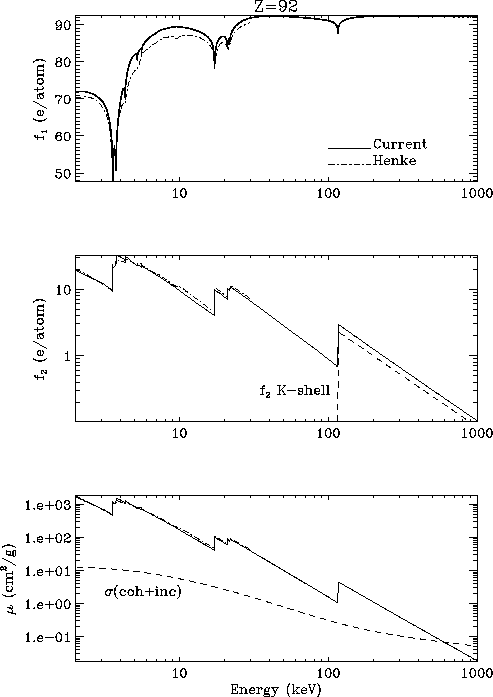
Here the atomic scattering factor is given for Uranium at medium X-ray energies (keV). Click the figure for the corresponding attenuation coefficients.
Some of our theoretical developments in the computation of form factors have resulted in significant improvements upon earlier work, which can be tested by suitable experiments. The computations have been confirmed in selected regions. Atomic form factors determine photoelectric cross-sections, elastic and inelastic scattering cross-sections and X-ray (Bragg-Laue) coherent diffraction profiles. Major discrepancies exist between theory and experiment. The Web database has been receiving 20000 hits per month since electronic installation as one of the three major references for atomic form factors and attenuation coefficients. Reliable knowledge of these factors is required for conventional fields such as crystallography and radiography, and also for the new fields of X-ray Anomalous Fine Structure (XAFS) and Multiple-wavelength Anomalous Dispersion (MAD).
Our theoretical work in relativistic atomic structure and spectroscopy has led to an investigation of the role of QED (self-energy) in these codes and in the corresponding spectra, linking up to the experimental QED tests:See
and investigations of correlation terms:
247. P H Dong, T V B Nguyen, S M Krstevski, C T Chantler, Zinc K beta ab initio diagram and satellite transitions J Phys B59 (2026) 045002 - 1 – 26. doi.org/10.1088/1361-6455/ae43d7 Supplementary Information
241. J W Dean, S N Thompson, C T Chantler, Ab Initio Manganese K alpha and K beta Energy Eigenvalues, Shake-Off Probabilities, Auger Rates, with Convergence Tests, Molecules 29 (2024) 4199 – 1 - 26. Doi 10.3390/molecules29174199 Supplementary Information
238. J W Dean, H A Melia, T V B Nguyen, C T Chantler, Scandium K alpha and K beta X-ray spectra with ab initio satellite intensities and energy eigenvalues, Phys. Rev. A 109 (2024) 022809 – 1 - 16 doi 10.1103/PhysRevA.109.022809 Supplementary Information
>> http://iopscience.iop.org/0953-4075 citing C. T. Chantler, J. A. Lowe, I. P. Grant, J. Phys. B 46 (2012) 015002
>>> Laboratory Highlight invited. A J Illig, C T Chantler, A T Payne, Determination of the 2p satellite profile through an improved characterization of copper K alpha, citing A J Illig, C T Chantler, A T Payne, Voigt Profile Characterisation of Copper K alpha, Journal of Physics B46 Sept (2013) 235001-1-11, http://m.iopscience.iop.org/0953-4075/labtalk-article/56166
For the major US Tabulations of atomic form factors and attenuation, see:
61. C. T. Chantler, Detailed new tabulation of atomic form factors and attenuation coefficients in the near-edge soft X-ray regime (Z=30-36, Z=60-89, E=0.1 keV 8 keV), addressing convergence issues of earlier work, J. Phys. Chem. Ref. Data. 29(4) (2000) 597-1056.
47. C. T. Chantler, Theoretical form factor, attenuation and scattering tabulation for Z=1-92 from E=1-10 eV to E=0.4-1.0 MeV, J. Phys. Chem. Ref. Data 24 (1995), 71-643.
Our recent experiments are two orders of magnitude more accurate than earlier work and reveal new physics, new processes and new applications. If we understand how light interacts with matter, we can use this insight in further applications.
The way that X-rays interact with matter should be well understood. However, deviations between latest theoretical computations lies at the 10% level over much of the energy ranges, for most elements. Even for the most investigated elements such as Si, Cu, Ag, Au, the few experiments which claim 1% precision show variation of 5-30%. We are addressing this with synchrotron experiments and with state-of-the-art facilities. Recent results have broken through this barrier to an unprecedented 0.01% precision and 0.02%-0.3% accuracy - an improvement of two orders of magnitude over previous work.
See e.g.
246. R Rijal, Jack A Stephens, N T T Tran, D Sier, J W Dean, T V B Nguyen, T Kirk, C Q Tran, S Diaz-Moreno, C T Chantler, Discovering Hidden Satellites in Mn K alpha using Novel High-Accuracy Fluorescence, with PCA revealing the Evolution of Quantum Processes, Nature Scientific Reports 16 (2026) 3634 1-1-16 doi.org/10.1038/s41598-025-33674-4 https://rdcu.be/e0V0G
243. D Sier, N T T Tran, T Kirk, C Q Tran, S Diaz-Moreno, J F W Mosselmann, C T Chantler. High Accuracy, High-Accuracy High-Resolution Measurements of Fluorescence in Manganese using Extended-Range High-Energy-Resolution Fluorescence Detection. J Applied Cryst 58 (2025) 42-59 doi 10.1107/S1600576724010574
238. J W Dean, H A Melia, T V B Nguyen, C T Chantler, Scandium K alpha and K beta X-ray spectra with ab initio satellite intensities and energy eigenvalues, Phys. Rev. A 109 (2024) 022809, 1-16 doi 10.1103/PhysRevA.109.022809
>> http://iopscience.iop.org/0953-4075 citing C. T. Chantler, J. A. Lowe, I. P. Grant, J. Phys. B 46 (2012) 015002
7. C. T. Chantler, "Towards improved form factor tables", pp 61-78, Invited review chapter in Resonant Anomalous X-Ray Scattering. Theory and Applications, G. Materlik, K. Fischer, C.J. Sparks, eds, (Elsevier, North-Holland, 1994).
X-ray Absorption Fine Structure (XAFS) is a complex structure seen in the absorption coefficient just above the absorption edge, where an incoming X-ray has enough energy to ionise an electron from a particular bound state. The oscillations seen are particularly due to an interference effect between the emitted photoelectron and its own reflected wave. This signature allows many investigations of local structural information for crystallographers, chemists, medical scientists, mining and engineering investigations.
Medical and biomedical research depends upon linking structure to function, and is dominated by the dynamics of active centres. This lies at the centre of XAFS research whenever the key catalytic agent is metallic or has an atomic number above 10.
Some third or more of Australian synchrotron research uses X-ray Absorption Spectroscopy and X-ray Absorption Fine structure (XAFS, and the related technique called XANES) to identify bond distances, chemical valence, nearest neighbour coordination and geometry, and local structure.
Our new experimental techniques allow XAFS determination with an accuracy increased by up to two orders of magnitude, which in turn challenges all available theory and modelling. Our analytical work puts these discrepancies on a firm foundation, and our theoretical development holds promise to develop new tools and methods of insightful analysis.
We have produced the first encyclopaedia on X-ray Absorption Spectroscopy, by the International Union of Crystallography, edited with Bruce Bunker and Federico Boscherini,
https://www.iucr.org/news/newsletter/etc/articles?issue=158542&result_138339_result_page=7
https://www.iucr.org/news/newsletter/etc/articles?issue=158542&result_138339_result_page=8
The encyclopaedia, ITCI, can be found on Amazon, IUCr and Wiley.
With Yves Joly, Chris Ryan, Don MacNaughton, Stephen Best, Zwi Barnea and others, we worked to develop theoretical and experimental resources for XAS for high-accuracy experiments and extreme chemistry and earth science investigations.
See e.g.:
246. R Rijal, Jack A Stephens, N T T Tran, D Sier, J W Dean, T V B Nguyen, T Kirk, C Q Tran, S Diaz-Moreno, C T Chantler, Discovering Hidden Satellites in Mn K alpha using Novel High-Accuracy Fluorescence, with PCA revealing the Evolution of Quantum Processes, Nature Scientific Reports 16 (2026) 3634 1-1-16 doi.org/10.1038/s41598-025-33674-4 https://rdcu.be/e0V0G
243. D Sier, N T T Tran, T Kirk, C Q Tran, S Diaz-Moreno, J F W Mosselmann, C T Chantler, High-accuracy high-resolution measurements of fluorescence in manganese using extended-range high-energy-resolution fluorescence detection, J Applied Cryst 58 (2025) 42-59 doi 10.1107/S1600576724010574
242. Chantler, C T, Diaz-Moreno, S, Bunker, G, D’Angelo, P, X-ray absorption spectroscopy, Nature Reviews Methods Primers 4 (2024) 89 - 1 - 25 doi.org/10.1038/s43586-024-00366-8
99. J. D. Bourke, C. T. Chantler, C. Witte, Finite Difference Method Calculations of X-ray Absorption Fine Structure for Copper, Physics Letters A, 360 (2007), 702-706 [First demonstration that Finite Difference Method theory can be applied successfully in the XAFS regime.]
93. C. Witte, C. T. Chantler, E. C. Cosgriff, C. Q. Tran, Atomic cluster calculation of the X-ray near-edge absorption of copper, Radiation Physics & Chemistry 75 (2006) 1582-1585 [Proof of concept for the Finite Difference Method for XANES in copper]
The experimental measurements and high accuracy have a long history enmeshed with developments of synchrotron diagnostics and calibration systems. Our development of the X-ray Extended Range Technique, XERT, in general has achieved measured precision and accuracy some 50 or 100 times better than previous work and techniques. This leads to new areas of inquiry, new challenges for standard and advanced theory of XAFS, XANES, XES, DFT, MCDHF, new signatures and investigations of harmonic contamination, fluorescence scattering, roughness, energy calibration, crystal and powder lattice and diffraction standards, strain, electron inelastic mean free path and other areas.
Selected highlights follow:
235. C T Chantler, Int. Tables Crystallogr. I (2024). Part 7, Chapter 7.4, Tables and Supplementary Material for X-ray Absorption Spectroscopy, pre-edge, XANES and XAFS, pp 867-925, doi.org/10.1107/97809553602060000116 International Tables for Crystallography, Volume I: X-ray Absorption spectroscopy and Related Techniques Supplementary Information
227. C T Chantler, Int. Tables Crystallogr. I (2024). Chapter 3.43, X-ray Extended Range Technique, XERT, for higher accuracy measurement and higher significance of X-ray Absorption Spectroscopy, pp 558-563, doi.org/10.1107/S1574870723009485 International Tables for Crystallography, Volume I: X-ray Absorption spectroscopy and Related Techniques
104. J. L. Glover, C. T. Chantler, The Analysis of X-ray Absorption Fine Structure: Beam-line independent interpretation, Meas. Sci. Tech. 18 (2007) 2916-2920 [How XERT resolves major anomalies in current research.]
65. C. T. Chantler, C. Q. Tran, D. Paterson, Z. Barnea, D. J. Cookson, Direct Observation of Scattering Contribution in X-ray Attenuation
Measurement, and evidence for Rayleigh scattering from copper samples rather than thermal-diffuse or Bragg-Laue scattering, Rad. Phys. Chem. 61 (2001) 347-350.
Some first-fruits:
246.
R Rijal, Jack A Stephens, N T T Tran, D Sier, J W Dean, T V B Nguyen, T Kirk, C Q Tran, S Diaz-Moreno, C T Chantler,
Discovering Hidden Satellites in Mn K alpha using Novel High-Accuracy Fluorescence, with PCA revealing the Evolution of Quantum Processes,
Nature Scientific Reports 16 (2026) 3634 1-1-16
doi.org/10.1038/s41598-025-33674-4 https://rdcu.be/e0V0G
243.
D Sier, N T T Tran, T Kirk, C Q Tran, S Diaz-Moreno, J F W Mosselmann, C T Chantler,
High-accuracy high-resolution measurements of fluorescence in manganese using extended-range high-energy-resolution fluorescence detection,
J Applied Cryst 58 (2025) 42-59 doi 10.1107/S1600576724010574
242.
Chantler, C T, Diaz-Moreno, S, Bunker, G, D’Angelo, P, X-ray absorption spectroscopy, Nature Reviews Methods Primers 4 (2024) 89 - 1 - 25
doi.org/10.1038/s43586-024-00366-8
Measurement and Theory of the Inelastic Mean Free Path of the [Photo-]Electron is a new field, because both theory and experiment are largely intractable for low energy electrons.
Our X-ray technique is able to orthogonalise and separate elastic, coherent scattering, which adds to the signal, from inelastic scattering processes,
which dampen the signal, as opposed to most other techniques where all such scattering dampens the signal.
Hence it can be much more sensitive.
It is particularly sensitive at low [photo-]electron energies, where other measurement techniques fail, and especially below 200 eV or so.
It depends upon the approximate validity of advanced non-muffin-tin Density Functional Theory and time-Dependent Density Functional Theory
to define the broadening due to the inelastic dampening of the photoelectron wave and hence the thermal
and non-thermal broadening of the XAFS and XANES signal.
This in turn depended upon the development of the Coupled Cluster Theory of Plasmons and plasmon scattering and their
impact upon the photoelectrons after ionization from X-ray photon excitation.
Our experimental and theoretical approaches show great promise and for the first time can define and inform new experimental
and theoretical methods for EELS and LEED, for ELFs and IMFPs.
See:
222.
C T Chantler, J D Bourke,
Int. Tables Crystallogr. I (2024). ch. 2.25,
Key physico-chemical parameters and significance, and tabulations, pp 230-269, doi.org/10.1107/S1574870720016511
International Tables for Crystallography, Volume I: X-ray Absorption spectroscopy and Related Techniques
Supplementary Information
148. J. D. Bourke, C. T. Chantler,
Theoretical and experimental developments in the determination of electron energy loss functions and inelastic mean free paths in elemental solids and
binary compounds,
J. Phys. CS 388 (2012) 132008
137. J. D. Bourke, C. T. Chantler,
Density functional calculations of electron energy loss data and inelastic mean free paths in elemental and binary materials
Acta Cryst A67 (2011) C170
Non-destructive Measurement of Nanoroughness is a challenging new field. Rather than micro- or nano- mapping of samples in a microprobe or scanning technique,
at a synchrotron beamline or elsewhere,
this has led to being able to measure the nanoroughness of a sample within the spot-size of the probe beam,
whether slit-defined or focussed or from a synchrotron optic or otherwise.
Whilst standard scanning and mapping methods of microprobes are ideal for heterogeneous samples, those which are near-pure or at least uniform can be used to measure
inhomogeneities for quality control, for wedges, for defects, for surface or internal non-uniformities to a significantly higher level than the mapping step-size or spot-size.
Further, these defects or structural or density changes directly affect the measurement of X-ray absorption.
First-fruits include:
229.
M D de Jonge, C T Chantler, C Q Tran, Int. Tables Crystallogr. I (2024).
Chapter 3.47, Projected roughness in X-ray absorption Spectroscopy, pp 574-580, doi.org/10.1107/S157487072300277X
International Tables for Crystallography, Volume I: X-ray Absorption spectroscopy and Related Techniques
202. R S K Ekanayake, C T Chantler, D Sier, M J Schalken, A J Illig, M D de Jonge, B Johannesen, P Kappen, C Q Tran,
High accuracy mass attenuation coefficients, and X-ray absorption spectroscopy of zinc – the first X-ray Extended Range Technique-like
experiment in Australia,
J Synch Rad 28(5) (2021) 1476-1491 (doi: S1600577521005981)
Supp Info: journals.iucr.org/s
195. D Sier, G P Cousland, R S K Ekanayake, C Q Tran, J R Hester, C T Chantler,
High accuracy mass attenuation measurement and atomic structure determination of zinc selenide through the X-ray Extended Range Technique,
J Synch Rad. 27 (2020) 1262-1277
Supplementary Information
Some highlights include:
235.
C T Chantler, Int. Tables Crystallogr. I (2024). Part 7, Chapter 7.4,
Tables and Supplementary Material for X-ray Absorption Spectroscopy, pre-edge, XANES and XAFS, pp 867-925, doi.org/10.1107/97809553602060000116
International Tables for Crystallography, Volume I: X-ray Absorption spectroscopy and Related Techniques
Supplementary Information
223.
S P Best, C T Chantler,
Int. Tables Crystallogr. I (2024). ch. 3.14, Chapter 3.14 Accurate data, mapping sample absorption and thickness effects, pp 375–394 doi.org/10.1107/S1574870720007673
International Tables for Crystallography, Volume I: X-ray Absorption spectroscopy and Related Techniques
201. F Wang, N Mohammadi, S P Best, D Appadoo, C T Chantler,
Dominance of eclipsed ferrocene conformer in solutions revealed by the IR spectra between 400 and 500 cm-1,
Radiation Physics and Chemistry 188 (2021) 109590 - 1 - 7
Archive 1306.0633.pdf https://arxiv.org/abs/1306.0633
172. C. T. Chantler, M. T. Islam, S. P. Best, L. J. Tantau, C. Q. Tran, M. H. Cheah, A. T. Payne,
High accuracy X-ray Absorption Spectra of mM solutions of nickel(II) complexes with multiple solutions using transmission XAS.
104. J. L. Glover, C. T. Chantler,
The Analysis of X-ray Absorption Fine Structure: Beam-line independent interpretation,
Meas. Sci. Tech. 18 (2007) 2916-2920 [How XERT resolves major anomalies in current research.]
See e.g.
247.
P H Dong, T V B Nguyen, S M Krstevski, C T Chantler,
Zinc K beta ab initio diagram and satellite transitions J Phys B59 (2026) 045002 - 1 – 26.
doi.org/10.1088/1361-6455/ae43d7
Supplementary Information
246.
R Rijal, Jack A Stephens, N T T Tran, D Sier, J W Dean, T V B Nguyen, T Kirk, C Q Tran, S Diaz-Moreno, C T Chantler,
Discovering Hidden Satellites in Mn K alpha using Novel High-Accuracy Fluorescence, with PCA revealing the Evolution of Quantum Processes,
Nature Scientific Reports 16 (2026) 3634 1-1-16
doi.org/10.1038/s41598-025-33674-4 https://rdcu.be/e0V0G
238.
J W Dean, H A Melia, T V B Nguyen, C T Chantler,
Scandium K alpha and K beta X-ray spectra with ab initio satellite intensities and energy eigenvalues,
Phys. Rev. A 109 (2024) 022809, 1-16 doi 10.1103/PhysRevA.109.022809
Supplementary Information
Powder Diffraction is often required for structural determination of biologically
active molecules, viruses, proteins or enzymes as well as for small inorganic molecules, especially
where the samples cannot be grown into large crystals. Standards for powder diffraction are well-known and widely used; though not frequently used
in local Australian research. These standards are dominated by pure silicon powder and lanthanum hexaboride
powder, which are the two principal lattice (and intensity) standards used in the world today.
These standards are maintained by NIST. They determine the lattice parameter of
an unknown sample under investigation and are a critical tool in determining
the synchrotron beam energy in an experiment.
Additionally, they monitor and can reveal several types of systematic errors in typical experiments. In recent work using the X-ray Extended Range Technique (XERT) we have redetermined the
lattice spacing of the second standard (LaB6) compared to the primary standard (Si) and find several
standard deviations of discrepancy. This (i) proves that synchrotron techniques can be used to determine
such standards and (ii) is the most accurate determination of lattice spacing except for that of silicon
itself. This opens up the way for the implementation of new standards and methods of analysis. See e.g.
226.
C Q Tran, C T Chantler, C T, M D de Jonge, Int. Tables Crystallogr. I (2024).
Chapter 3.42, Energy Calibration for X-ray Absorption Spectroscopy, using Powder and Single Crystal Standards, pp 549-557,
International Tables for Crystallography, Volume I: X-ray Absorption spectroscopy and Related Techniques
doi.org/10.1107/S1574870723004044
101. C. T. Chantler, N. A. Rae, C. Q. Tran,
Accurate determination and correction of the lattice parameter of LaB6 (standard
reference material 660) relative to that of Si (640b), J. Appl. Cryst. 40 (2007) 232-240 [New technique for powder diffraction standards.]
95. N. A. Rae, C. T. Chantler, C. Q. Tran, Z. Barnea,
High-Precision Energy Determination of Synchrotron Radiation From Powder
Diffraction and Investigation of Profile Widths,
Radiation Physics & Chemistry 75 (2006) 2063-2066 [New technique for energy calibration.]
Earth Sciences, Mineralogy, Organometallics, Biophysics, Bioscience, and Biomedicine impact upon X-ray diffraction theory.
My diffraction theory is the first dynamical theory for non-ideally imperfect curved crystals
(and simpler subclasses) and shows significantly greater agreement for perfect curved crystal profiles than previous work. The X-ray interaction with photographic emulsions is an interesting application of
ideas from basic physics.
Active areas of interest and development include ion chamber
optimisation, new detector technology, state-of-the-art spectrometry
and 2-dimensional (backgammon) proportional counters. Applications of these ideas have led to new calibration devices for radiography and mammography, patented in the US as part of the Quantum
Metrology Group effort in the Atomic Physics Division at the National Institute for Standards and Technology, USA. See e.g.
eXtended Range - High Energy-Resolution Fluorescence Detection for high-accuracy absorption and scattering measurement
The high resolution fluorescence detection technique at synchrotrons, HERFD, which has led to advances in RIXS, REXS, NRIXS techniques,
has been developed by us at Diamond Light Source to create the XR-HERFD technique - eXtended-Range HERFD - which has been shown able to double the prior resolution of the technique.
It has also led to our numerous discoveries of new physical processes in the XES (X-ray Emission Spectrum) axis.
It has proven that not only is S02 not a constant, but also that it evolves with these previously unseen and unknown processes, across different ranges of energy, and also that
these processes contribute up to 20% or more to the Kα spectra, and to others. So these processes are critical in defining both XAFS vis a vis the Standard XAFS Equation;
and also in defining the theory of HERFD, RIXS, RXES, and XR-HERFD by contra-distinction.
Some core details of the new technique include: New scanning and data acquisition methods and loops;
definition of statistical precision and working towards definition of statistical accuracy;
propagation of data point uncertainty to experimental fitting and analysis; work towards calibration of energy axes;
full use and analysis of the binary data from Medipix images; separation of all analyser crustal images; analyser crystal masking where appropriate or needed;
alignment of all analyser crystal images (3 or 7 or 14, depending upon experimental geometry and opportunity)
binary splicing of each analyser crystal image in the dispersion axis;
Medipix image background subtraction from fluorescence signal; prediction of XES energy onset of new processes;
prediction of XAS incident energy ranges of new processes; investigation of spectra over an eXtended Range of incident and emission energy to locate and observe the processes;
analysis with advanced Principal Component Analysis...
Band Theory, Cluster Theory, FDMX: Measurement and Theory of the Inelastic Mean Free Path of the [Photo-]Electron:
Non-destructive Measurement of Nanoroughness
Theoretical and Laboratory Astrophysics: Aurorae, Spectra and Theory, Solar and Astrophysics anomalies
Theoretical and Laboratory Astrophysics: Aurorae, Spectra and Theory, Solar and Astrophysics anomalies are important in understanding the
solar interactions with the upper atmosphere, the interaction with intermediate gases and ions, and the observed spectra.
We have been invited to address some critical problems involving anomalies in astrophysical observations and data.
Tools to investigate these in laboratory sources or using advanced theory can reveal key pieces of outstanding problems and puzzles.
Biophysics: Biomedical and Chemical Applications, Alzheimer's and Mammography
Application of advanced experimental and analytical techniques can find great outcomes in biophysics, biomedicine, applied chemistry, Alzheimer's research and mammography.
Accurate theory and experiment crosses boundaries and becomes intrinsically interdisciplinary.
While this can be seen in our application in imaging, they are far more significant in spectroscopy, diffraction and XAFS,
as these are the dominant techniques used at synchrotrons and ergo have the greatest opportunities.
Plasma Physics: Electron beam ion traps, anode physics, multiple
ionisation processes, X-ray Free Electron Lasers, satellites
Several of our studies have provided great insight into the physical processes occurring in low-density and medium-density plasmas at
electron-beam-ion-traps, anode physics, multiple ionisation processes, X-ray Free Electron Lasers and satellite spectra.
Each of these sources are related but involve quite disparate physics and timescales.
These include the first absolute polarisation measurement at an EBIT;
and investigated key plasma processes and dynamics in highly ionized systems. Plasmas in astrophysical sources, aurorae, accelerators,
EBITs and Tokamaks are of extreme interest in interpreting anomalies and dynamics, as well as long-term energy sources.
A new EBIT proposal linked to a synchrotron offers the possibility of
direct inquiry into laboratory-controlled understanding of dynamic interactions in plasmas.
Recent theory and experiment on characteristic spectra have shown and proven the multiple-ionisation processes and the development of plasma processes.
Powder Diffraction, X-ray Diffraction and X-ray Crystallography:
Applications to Earth Sciences, Mineralogy, Organometallics, Biophysics, Bioscience, Biomedicine
Last modified: 2026
Copyright © 2026 The University of Melbourne